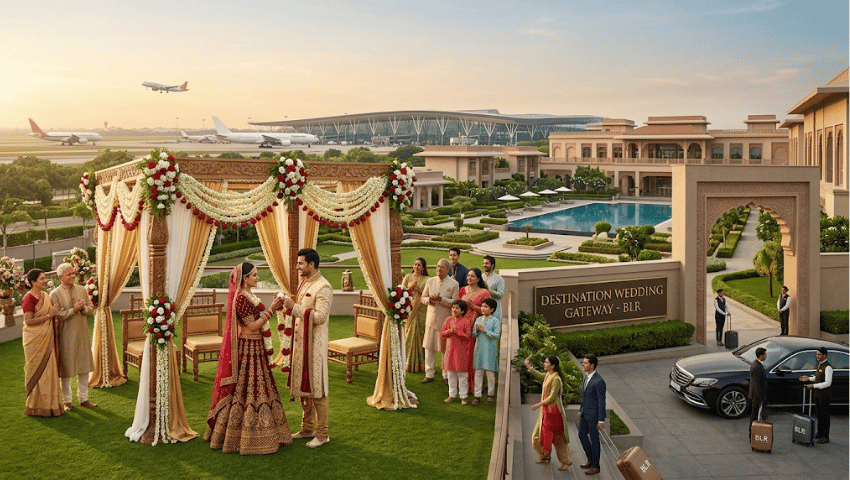


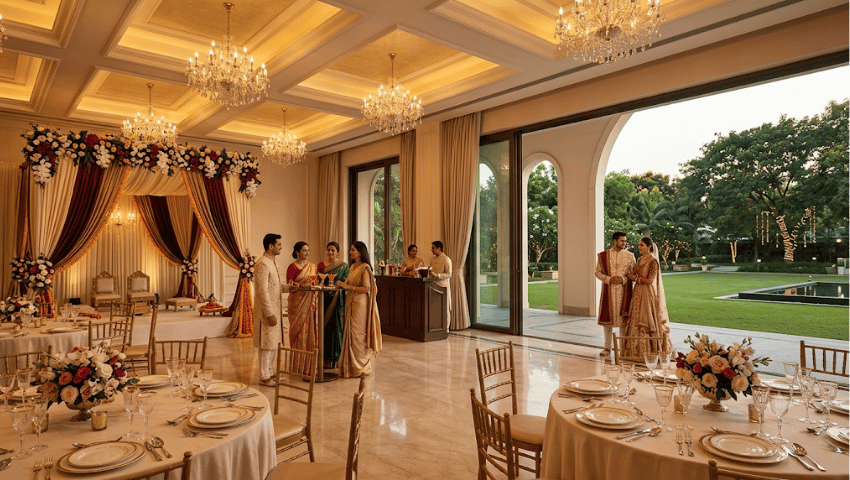
When a luxury venue earns its price, you feel it in ways that are hard to point to but impossible to miss. Guests who never had to search for a seat. Food that people bring up on the drive home. A day that moved the way it was supposed to, without the hosts ever needing to step away from it. That is the real measure of a premium wedding hall in Bangalore, and it has very little to do with how the brochure reads.
When the Venue Search Gets Real
Families rarely begin the venue search expecting it to be complicated. The wish list going in is usually straightforward: a hall that feels right, food worth remembering, guests who are well looked after, and a day that moves without friction. That picture stays clear and confident right up until the actual visits begin, and then the details start arriving faster than the answers.
One venue is stunning in person, but it sits far enough from the city that guests are adding a serious stretch of drive time to their evening. Another comes in at a price that feels manageable until you read through the actual inclusions. A third checks almost everything on the list, right up until you find out the parking accommodates forty vehicles and your guest count is hovering around three hundred.
A venue page is designed to impress, and it usually does. What it cannot show you is how the entrance holds up when two hundred guests arrive in the same twenty minutes, or how quickly the hall starts to feel smaller once the stage, the tables, and the buffet counters are all in place. That version of the space only reveals itself on the day.
A higher price tag does not come with a guarantee. Some Bangalore venues charge what they charge because the name carries weight in certain circles, and that is more or less where the value ends. Others, at the same price or close to it, quietly get everything right on the day and let the experience speak for itself. That gap rarely shows up on a venue tour. It shows up at the wedding. So rather than letting the number do the deciding, use this guide to push past the surface, ask the questions that actually matter, and spend where your guests will genuinely feel the difference.
Here is what you will take away:
- How to judge real value beyond the price tag
- The venue details that quietly make or break the day
- A hands-on checklist to compare venues clearly and make your final call with confidence
Why Choosing a Wedding Venue Feels So Hard in Bangalore
Bangalore does not have a venue shortage. It has a shortlist problem. Open any search, and within a few minutes you are looking at dozens of halls that each claim to offer exactly what you need. The more you scroll, the harder the decision gets, and most families land somewhere between a long tab collection and a genuine headache, no clearer on what actually separates one option from the next.
Most families run into the same set of challenges.
Venue confusion from photos alone
Venue listings are built to attract, not to inform. The photos go up when the hall is empty and the light is cooperating, not when four hundred guests are working their way through a buffet line. A space that reads as expansive on screen can feel narrow and busy once the stage goes in, the tables fill out, and people start moving around in it. You do not get that version of a venue from a search result. You only get it on the day.
Budget uncertainty
Look at two venues quoting the same figure and you might be looking at completely different things. One price bundles in catering, staff, and full setup. The other is just the hall, with food, decor, and everything else billed separately. When the breakdown is missing, you end up comparing a finished product with a starting point, and that is not a real comparison at all.
Bangalore traffic and location
Shaving a few thousand off the rental cost means very little when your guests are adding ninety minutes of Bangalore traffic to their evening. They arrive drained, the mood in the room starts lower than it should, and no amount of good lighting fixes that. The commute is part of the guest experience, whether or not it shows up on any venue checklist.
Parking that cannot keep up
Guests do not trickle in. They arrive in clusters, cabs pulling up one after another, hired buses offloading at the gate, family cars circling for a spot. A parking setup that cannot absorb that kind of arrival pressure creates friction before a single welcome drink has been served. And for older relatives who already find large gatherings tiring, being left to walk a long stretch from wherever the car finally found space is not a minor inconvenience. It is the kind of detail that sets a poor tone before they have even stepped through the door.
Catering expectations
Talk to guests after any wedding and the conversation almost always circles back to the same thing. Not the centerpieces. Not the draping. The food. A hall can photograph beautifully and still leave people quietly disappointed if the meal does not hold up. Buffet counters that empty out too soon, dishes that arrive at the wrong temperature, service that cannot keep pace with the crowd – these are the details that stick long after the decorations have been packed away.
Monsoon planning
Bangalore rain is not something you negotiate with. It shows up when it wants, sometimes for twenty minutes, sometimes for the rest of the evening, and it rarely cares that you have four hundred guests seated outdoors. A venue that cannot shift an entire function indoors quickly and smoothly is not offering you a garden option. It is offering you a risk.
Knowing what can go wrong makes you a sharper evaluator. The questions change, the visits get more productive, and the options that were never right for you stop wasting your time.
What Actually Makes a Luxury Venue Worth the Budget
A high price tag should tell you something real about what you are getting. The venues that consistently earn it rarely shout about it. They show up in details that are harder to photograph but easier to feel.
Space that fits your guest list comfortably
A number on a venue’s capacity sheet tells you very little about how the space actually lives on the day. That figure was not calculated with your stage dimensions in mind, or the buffet counters running along the side wall, or the fact that guests need room to actually move between where they are sitting and where they want to go.
A useful rule:
- Build in a buffer of roughly 15 percent above your actual guest count, not just your confirmed list
- Ask about capacity for your specific setup, because a seated dinner fills a hall very differently than an open reception
- Find out how the venue manages the shift between ceremony and dining, since that transition is where crowding tends to peak
A well-sized hall changes the feel of an entire evening in ways guests sense but rarely name. Nobody announces that they found their table easily, or that the buffet moved quickly, or that they never felt hemmed in. They just enjoy themselves. Crowd a space beyond its natural limit and the opposite happens: people bunch up, energy drops, and guests start eyeing the exit well before the evening is done.
Food and service that match the setting
At the better end of Bangalore’s wedding venue market, food stops being a supporting act and starts being treated like the main event – because experienced hosts know that is exactly how guests experience it.
Look closely at:
- A menu broad enough to cover different cuisines and accommodate dietary needs without making anyone feel like an afterthought
- Service formats handled properly, whether that is a live counter, a buffet line, or a plated course, each one run with the same level of care
- Dishes that reach guests while they are still at their best, not whenever the kitchen finds a moment
- A consistent standard from the first plate served to the last, because a great tasting session means very little if quality drops once the hall fills up
The gap between two halls at the same price point often has nothing to do with the decor or the floor plan. It comes down to what happens in the kitchen and how the service team carries that food to four hundred people without the quality slipping halfway through the evening.
Guest comfort at every step
Luxury is felt in small details. Clean and plentiful washrooms. Comfortable seating. Good air conditioning. Clear signage. Easy movement for elderly guests and children.
These things rarely appear in listings, yet they define the guest experience more than the decor does. A venue that gets comfort right makes your family look like gracious hosts without any extra effort.
Professional coordination
Most of what goes wrong at a wedding never reaches the hosts. An experienced team intercepts problems early, adjusts quietly, and keeps the schedule moving without pulling anyone away from the celebration to deal with it.
This is the quiet luxury families appreciate most. You stay present at your own celebration instead of managing logistics.
A reliable indoor backup
Given Bangalore monsoons, a covered alternative is not a nice extra. It is essential. The best premium event spaces let you move a function indoors quickly if the weather turns, without derailing the schedule.
Capacity and Cost: Planning the Numbers
The budget conversation is the one most families quietly put off, and putting it off is usually what turns a manageable number into a genuinely unpleasant one once the final invoice lands.
Understand what the quote includes
Before comparing figures, ask each venue what the price actually covers.
- Hall rental and setup hours
- Catering per plate and any minimum guarantee
- Service staff and coordination
- Basic decor versus premium decor
- Taxes and any add on charges
Side by side, two quotes can look almost identical and mean completely different things. One has absorbed the real costs. The other has pushed them further down the road, where they will show up later, larger, and harder to argue with. A line by line breakdown is the only way to see which is which.
Match capacity to your real guest count
Guest lists in Indian weddings tend to move in one direction only. The number you had three months ago will almost certainly be lower than the one that shows up on the day, and planning around the conservative figure is how halls end up feeling stretched. Aim for the upper end of your estimate. A room with a little space left over feels easy and relaxed. One that is running at its absolute limit announces that fact to every guest in it.
Keep a contingency
Set aside a small buffer, somewhere in the range of five to ten percent, for the parts of the day that do not announce themselves in advance. An unplanned function, a guest count that nudges higher in the final week, an extra round of refreshments when the evening runs long. These things happen at almost every wedding. Having a little room in the budget to absorb them quietly is far less stressful than negotiating each one as it appears.
Common Mistakes Families Make
The same handful of planning errors show up again and again, and they tend to cost families far more than just money.
- Booking on looks alone. A gorgeous hall with weak food or thin service disappoints where it counts.
- Ignoring travel time. A distant venue can cost guests hours and dampen attendance.
- Underestimating parking. Nothing frustrates arriving guests faster than nowhere to park.
- Skipping the indoor backup question. One rainy evening can undo months of planning.
- Always taste before you commit. No menu description prepares you for what four hundred guests will actually eat. Ask for a tasting session and judge it honestly.
- Matching prices do not mean matching value. Read every line of what each quote actually covers before you put two venues side by side.
- Forgetting outstation guests. If family travels in, on site or nearby stay options matter a lot.
Spot these gaps early, and the entire process gets cleaner. Your visits become more focused, your conversations with venue teams get more specific, and when you do make a final call, it is one you can actually stand behind.
Why This Topic Matters Right Now
Indian weddings have always been big. What has changed is what families expect from them.
The India wedding services market hit approximately USD 32.98 billion in 2025, with venue and catering services pulling the largest share of that total. Behind the number is a quieter story: families are spending more because they expect more in return. A hall that looks the part is no longer enough on its own. The experience it delivers, the food, the service, the comfort, is where the real judgment happens now, and that bar keeps moving.
A few observable trends stand out:
- Higher expectations on food and service. Guests notice quality, and hosts want kitchens that deliver at scale.
- Preference for professionally managed venues. Families increasingly value venues with experienced coordination over standalone halls that leave logistics to them.
- Demand for convenience. The all in one model, where the venue handles space, food, service, and stay, keeps gaining popularity because it reduces planning stress.
- Comfort as a priority. Guest comfort now sits alongside aesthetics when families judge a venue.
The takeaway is simple. Couples and families are not just paying for a beautiful hall. They are paying for a smoother, more comfortable, better managed celebration. That is what “worth the budget” means in the current market.
Where Brigade Hospitality Fits In
Among hospitality venues in Bangalore, Brigade Hospitality has built a reputation for bringing several experiences together under one trusted name. That range is genuinely useful when you are planning something as important as a wedding.
Rather than a single hall, the group offers a spread of settings and services:
- Wedding and celebration spaces suited to intimate functions and large gatherings alike
- Banquet halls in Bangalore with the setup and service premium celebrations need
- Club and resort experiences that add a refined backdrop to your event
- Convention and conference halls for the corporate side of hospitality
- Professional dining and catering handled by experienced teams
- Support for different event sizes and formats, from a quiet ceremony to a grand reception
A wedding rarely fits into a single afternoon. Functions stretch across days, relatives fly in from different cities, and the coordination required to hold all of it together is its own full-time job for whoever ends up managing it. A hospitality group that regularly runs large-scale corporate gatherings, team offsites, and multi-day stays has already solved most of these problems before. That experience doesn’t disappear when the occasion changes. It simply gets applied to a different kind of day.
Well-placed properties mean guests aren’t fighting traffic to get there, parking doesn’t grind to a halt the moment the first wave of cars arrives, and the host isn’t fielding frantic calls about directions all evening. The care that Brigade Hospitality brings to its club spaces, dining experiences, and large-scale events doesn’t get shelved when the occasion is a wedding. It travels with the team, and it shows in the same quiet, consistent way.
None of this replaces your own visit and comparison. It simply gives you a trusted starting point, with the kind of all in one support that removes much of the usual planning weight.
Your Wedding Venue Decision Checklist
Before you sign anything, go through each point honestly. The venues that hold up under these questions are the ones worth your time and, eventually, your deposit.
- Guest capacity: With your stage, dining layout, and guest count all accounted for, does the hall still give people room to move?
- Location accessibility: Can the majority of your guests reach the venue without it eating into the evening before they even arrive?
- Parking availability: When guests start arriving all at once, as they always do, does the venue have the capacity to absorb it without chaos?
- Food quality: Set aside the printed menu and ask for a tasting. Judge what is actually going to be served to four hundred people, not what looks good on paper.
- Indoor backup: If rain arrives mid-function, is there a fully prepared alternative that the team can shift to without disrupting the evening?
- AV support: Are lighting, sound, and display handled by someone who is present for the whole event, not just the setup?
- Stay options: For guests coming in from another city, is there somewhere decent to sleep that does not require a separate booking process?
- Staff coordination: Is one person clearly responsible for how the day runs, someone your family can go to if something needs resolving?
- Total package cost: Does the quote account for every charge upfront, or does it leave room for additions to appear closer to the date?
- Guest comfort: Have the small things been considered, the washrooms, the seating, the accessibility for older guests, the signage, the things that rarely appear in brochures but shape how people remember the day?
A venue that answers the hard questions well will give your guests a far better day than one that was simply built to impress on a screen.
Frequently Asked Questions
- What makes a luxury wedding hall worth the higher price?
A polished entrance and good lighting get you through the door. What keeps guests talking afterward is everything else. How quickly the buffet moved. Whether the staff noticed things before anyone had to ask. How the evening stayed on track without the hosts disappearing into logistics. A venue earns a premium price when it delivers on those quieter details, not just the ones that photograph well. - How much extra capacity should a wedding venue have?
A buffer of around 15 percent above your expected headcount is a sensible place to start. Guest lists in Indian weddings have a way of growing right up to the day, and that extra room keeps the hall from feeling stretched when numbers come in higher than planned. Also worth asking: what does capacity look like for your actual setup? A seated dinner and a standing reception use the same space very differently, and that distinction matters more than the number on the brochure. - What should a wedding venue quote include?
A quote that skips the detail is a quote that leaves room for surprises. Before you treat any figure as a real number, confirm it covers hall rental, setup time, food per head, service staff, event coordination, decor level, and taxes. Once you have that full picture from each venue, the comparison becomes honest. A hall that looks like the budget option on first read often stops looking that way once everything missing from the quote gets added back in. - How do I plan a Bangalore wedding around the monsoon?
Book any outdoor function and Bangalore’s rain will have its own opinion about how the evening goes. Before committing to a venue with open air elements, ask two things plainly: what does the indoor fallback actually look like, and how long does it take the team to get everything moved across when the sky decides to weigh in? Covered walkways, a properly equipped indoor space, and a team that has handled this transition before are not nice-to-haves. Without them, you are not managing a risk. You are accepting one. - Why do families prefer all in one wedding venues?
Splitting a two day celebration across multiple vendors sounds manageable until you are actually doing it. Separate contracts, separate timelines, separate people to chase when something slips. When the hall, the catering, the service staff, and the accommodation for traveling relatives all sit under one roof and one team, the planning gets quieter and the day gets steadier. One call handles most of it. One standard runs through all of it.
A Calmer Way to Choose Your Venue
Most venue decisions come down to a feeling you cannot quite name until after the day is done. Guests who moved through the evening without a single moment of friction. A meal that held up from the first plate to the last. A team that handled the small crises quietly, without pulling anyone away from the celebration to manage them. A location that people actually reached without dreading the journey. When a luxury wedding hall in Bangalore gets those fundamentals right, the cost stops being something you explain to yourself and becomes something the day simply confirms.
See the hall the way your guests will see it, not on a screen at your best angle. Walk to the parking area at the time of day your event starts. Request a proper tasting and judge what four hundred people will actually eat, not what looks good on a sample plate. Ask the venue team plainly what happens when it rains mid-function and listen for how quickly they answer. Read the quote against itself, line by line, until every charge has a name. That groundwork is not extra effort. It is the difference between a day that runs the way you pictured it and one that keeps you looking over your shoulder.
If you are planning a wedding and want a hospitality partner that brings space, dining, stay, and professional coordination together, Brigade Hospitality is a good place to begin the conversation. Reach out to explore available spaces and find the setting that fits your family and your celebration.