

Planning a corporate offsite in Bangalore usually starts off simply enough. The team decides they want to step out of the office for a day or two. Someone suggests a resort, another person prefers somewhere in the city, and soon there are plenty of questions flying around. How much time will everyone spend in traffic? Is it worth including an overnight stay? Does the venue need to have meeting rooms, open spaces, good food, and parking? Above all, what actually works best for the type of event you have in mind?
When you get into Corporate Offsite Planning in Bangalore, choosing between resorts and city venues entirely shapes the experience. It influences your budget, the energy of the day, team engagement, and even how people remember the gathering afterward. This guide compares both formats practically, focusing on what makes the most sense for companies in Bangalore.
Why this choice matters so much in Bangalore
Bangalore has a unique landscape for corporate events. Offices cluster in Whitefield, Electronic City, Koramangala, Outer Ring Road, and MG Road. So, the team’s starting point truly matters.
A venue that looks great on paper can lose its appeal if half the group spends two hours getting there. The opposite also holds true: a nearby location can mean a smoother event, less fatigue, and much better participation.
In practice, your decision between a resort and a city venue usually boils down to these factors:
- travel time for the group
- clarity around the budget
- team size
- need for formal meetings
- expectation for bonding and interaction
- need for overnight stay
- comfort for mixed groups
- how easy coordination will be on the day
When these factors are clear from the beginning, choosing the right venue feels much simpler.
Corporate Offsite Planning in Bangalore: when resorts work best
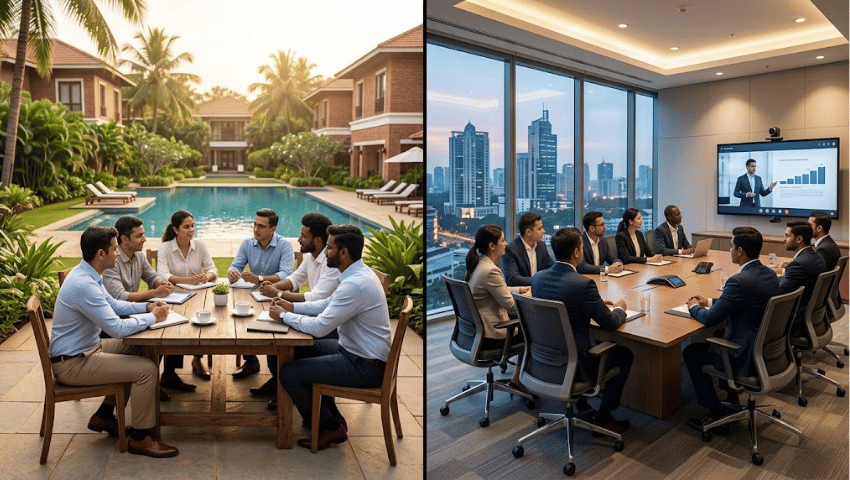
Resorts are a popular choice when a company wants to really break out of the daily routine. The shift in environment helps the team let go of their office mindset.
Best suited for full-day or overnight events
If your plan includes morning meetings, team activities in the afternoon, and dinner at the end of the day, a resort tends to make sense. The same is true for leadership retreats, strategy sessions, and team outings focused on deeper connection.
In and around Bangalore, many resorts comfortably handle:
- 30 to 80 people for more intimate sessions
- 80 to 200 people for medium scale offsites
- 200 to 500 participants for larger programs with open spaces and support halls
Event duration tends to follow a practical rhythm:
- day outings from 6 to 8 hours
- overnight offsites lasting 2 days
- strategy retreats of 2 to 3 days
More room to blend work and relaxation
One of the biggest advantages of a resort is the variety of spaces. You might start with a session in a hall, move to lunch in the dining area, hold outdoor activities on the lawn, and finish the day with an informal gathering.
This setup is especially useful when your goal is not just to set targets, but to build connection between teams. When colleagues from different departments gather, this type of atmosphere encourages natural conversations.
What to confirm before choosing a resort
Not every resort is ready for corporate offsites. Some work better for leisure than for meetings.
Before making a decision, make sure of the following:
- well equipped meeting spaces
- good sound, screen, and internet quality
- actual distance from your office
- comfortable rooms if there’s an overnight stay
- dining spaces that support large groups efficiently
- rain plan for outdoor activities
- parking that accommodates cars and buses
In short, resorts work best when your company wants quality time, a full program, and a less rushed experience.
When city venues are the practical choice
City venues tend to work best for companies that value efficiency. The team leaves the office, attends the event, and returns home the same day without losing energy.
Ideal for focused and well structured events
If your event centers on presentations, workshops, quarterly reviews, training, or meetings with internal clients, a city space is usually a better fit.
This format suits:
- meetings with 20 to 60 people
- workshops for 50 to 120 participants
- general gatherings of 100 to 300 people
- events that must wrap up in a single day
Often, conference and banquet halls within the city provide strong infrastructure with minimal logistical hassle.
Reduced impact from travel and traffic
This factor is a big one in Bangalore. A nearby venue can save the group a lot of commuting time and help boost both attendance and punctuality.
If your team spreads across areas like JP Nagar, Whitefield, Indiranagar, or Hebbal, it helps to look for locations that are easy to reach via main roads. This reduces delays, makes arrival by cab easier, and supports those driving themselves.
When city venues fall short
City venues may seem less appealing if you want long breaks, outdoor activities, or real immersion. If your team leaves the meeting and heads straight into city traffic, the offsite effect can feel incomplete.
City venues work better for clear schedules, tight timelines, and content driven programs rather than prolonged bonding.
Resorts vs. city venues: what changes for the team
In the end, the decision is not just about logistics. It shapes how your team experiences the occasion.
At resorts
The atmosphere is smoother. People expect to spend real time together, have deeper conversations, and join in activities beyond the main meeting.
This setup is especially good for:
- team integration
- annual gatherings
- leadership meetings
- recognition events
- activity based team outings
At city venues
The experience is more direct. The priority is on content, a clear agenda, and smooth execution.
This model tends to suit:
- training sessions
- meetings with a fixed agenda
- quarterly reviews
- internal presentations
- workshops with limited duration
In summary, resorts help support depth and real interaction, while city venues encourage objectivity and focus.
Venue structure: indoor, outdoor, and event flow
A common mistake is to focus only on the main hall. During an offsite, the flow between moments is just as vital as the meeting room.
What a good resort should offer
Besides the main area, you want:
- conference spaces for formal sessions
- lawns or outdoor areas for activities
- well organized dining
- sufficient restrooms
- spaces for breaks and walking around
- stay options for groups staying overnight
What a good city venue should offer
For city spaces, priorities shift a bit:
- meeting areas with good acoustics
- comfortable seating for several hours
- dependable internet
- screen, projector, and microphones
- coffee break stations near the meeting room
- parking or reliable valet
If your event mixes presentations with lunch and networking, the layout should minimize internal walking and help avoid long queues.
Budget: where differences really show
Many people compare only the base rental fee at first. In Corporate Offsite Planning in Bangalore, actual costs include much more than just the space.
Costs involved with resorts
At a resort, you usually get a broader package:
- primary event space
- meals and coffee breaks
- activities
- rooms, if staying overnight
- transportation, sometimes
- support staff throughout the event
The budget often ranges widely, but a typical corporate day outing may fall between ₹1,200 and ₹3,500 per person. For programs with overnight stays, costs rise with the venue category, dining, and number of rooms.
Costs involved with city venues
In-city venues often seem more affordable per person. For single day events, prices between ₹800 and ₹2,500 per person are common, depending on menu, technology, and duration.
Still, look for possible extras including:
- AV equipment rental
- overtime charges
- parking
- separate meals
- branding setup
- support rooms
To sum up, resorts can feel pricier at first but provide a fuller experience. City venues are often more efficient for concise and focused events.
Choosing by event type
If you still haven’t decided, start by defining your main objective.
Choose a resort if your event needs:
- genuine team bonding
- a more relaxed environment
- outdoor activities
- a full day or 2 day schedule
- accommodation for part of the group
- a more memorable experience
Choose a city venue if your event needs:
- fast access
- straightforward agenda
- everyone returning home the same day
- a strong focus on meetings
- ease for participants coming from across the city
- simpler time management
A practical way to decide: if the main benefit is connecting people, the resort option usually works better. If the main value is in crisp schedule execution, a city venue generally brings better results.
A real world decision scenario in Bangalore
Picture a company based on Outer Ring Road with 120 participants from various departments. The goal is to align new objectives and include a light team bonding session.
If the event is a single day, starting at 9 and ending at 5, a city venue with conference halls, onsite dining, and good parking probably delivers the best results. The group spends less time traveling and keeps energy focused on the core agenda.
Now consider a leadership retreat for 45 people, including strategy sessions, dinner, and informal talks through the next morning. For this situation, a resort with stay options simply fits better as group interaction continues beyond the main hall.
Making coordination easier: all-in-one venues
Companies often appreciate venues that simplify operational decisions. Here is where combined venues make a real impact.
Properties like Woodrose Club and other Brigade Hospitality spaces naturally feature on the shortlist for this reason. When a venue offers banquet halls, lawns, conference facilities, dining, stay options, and club experiences, coordination becomes much easier. This supports seamless transitions between meetings, meals, and activities, without making the event feel disconnected.
It goes beyond just having multiple spaces. The key is ensuring everything flows well for both organizers and participants.
Checklist before finalizing a venue
Before confirming, run through this list:
- is the event’s main aim crystal clear
- does the location work for most of the team
- can the space comfortably fit your group
- are there proper rooms for meetings and presentations
- is there a good dining option on site
- does the parking serve all cars, cabs, and buses
- has travel time been calculated based on Bangalore’s traffic
- is there a rain plan for outdoor areas
- does the budget anticipate all extras, not just the base rate
- do you have reliable support staff for the event day
Questions to ask before booking
During a visit or negotiation, clarify the following:
About the facilities
- what is the comfortable capacity for each room
- which tech equipment is already included
- is there a separate room for coordination or speakers
About operations
- how are coffee breaks and lunches managed for large groups
- how quickly can staff turn over rooms for the next session
- is technical support available during the event
About access
- how many parking slots are available
- can buses easily enter the premises
- does access get difficult during peak hours or rain
About costs
- what is covered in the final price
- which items carry an extra charge
- is there any price change for using both indoor and outdoor spaces
Common mistakes companies make when comparing venues
Several errors show up repeatedly in offsite planning.
Going only by aesthetics
A beautiful venue always helps. But if the acoustics are poor or the event flow gets stuck, the group’s perception can fall quickly.
Ignoring real travel time
In Bangalore, thirty kilometers may take far more time than expected. This affects energy levels, punctuality, and even willingness to join in.
Not matching event type to venue
A resort suits team outings but may be too much for a short meeting. On the flip side, a city venue may feel overly functional for an event needing deep connection.
Overlooking meals and breaks
For longer offsites, the quality and pacing of dining deeply shape the group’s mood. Slow or poorly timed meals can break the day’s momentum.
Corporate Offsite Planning in Bangalore: what to choose in the end
For most cases, the best choice comes down less to the venue type itself and more to what you want your event to accomplish. In Corporate Offsite Planning in Bangalore, resorts tend to support community, immersion, and an extended timeframe. City venues are usually more efficient for straightforward schedules, busy teams, and events that need to happen with minimal travel.
Ideally, compare spaces by how they support your entire event flow, not just by the main hall or the starting price. When location, structure, food, meeting spaces, and comfort all work together, your event usually runs much more smoothly. This is often the difference between a gathering that is simply well managed and one that really leaves a meaningful impact on your team.