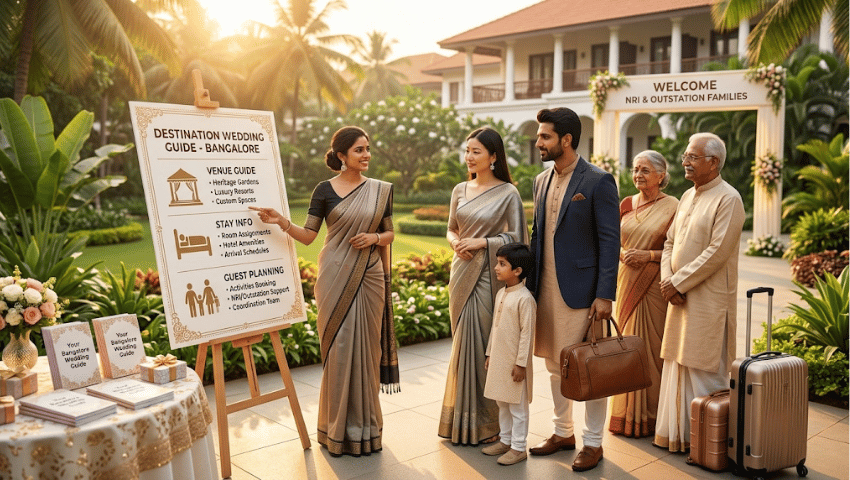


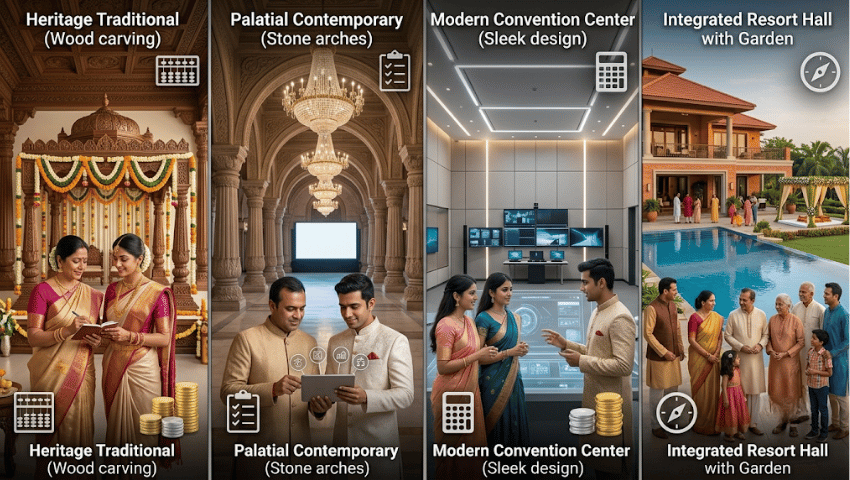
Bangalore wedding hall pricing covers more ground than most families anticipate when they first sit down to plan. A basic function space can start somewhere around ₹50,000 for the room itself. A fully serviced premium banquet, catering and staff included, can push past ₹3000 per plate without much difficulty. Where your family lands on that scale depends on how many people you are feeding, what the menu looks like, which part of the city the venue is in, and the time of year. The sections below break each tier down honestly so you can walk into venue conversations with a clear sense of what those numbers actually represent.
The Point Where the Real Conversation Starts
It rarely begins with a spreadsheet. A venue someone mentioned at a reception last season. A reel someone’s cousin forwarded into the group chat. A family dinner where everyone has a suggestion and no one has a budget figure. The energy is good until someone says the thing that quietly changes the temperature in the room. So what is all of this actually going to cost?
That question sends families straight to the search bar hoping for a direct answer. What comes back is a mix of pricing formats that resist easy comparison. One venue leads with a per plate figure and mentions the hall as a secondary detail. Another quotes only the room and saves the catering conversation for a different meeting. A third offers a tidy package that stays tidy until you start asking what falls outside it.
Read through this guide and you will come away with a clear picture of what wedding halls in Bangalore genuinely cost, why your headcount ends up shaping the total more than almost anything else, what a properly structured package should actually contain, and which questions are worth asking at every venue before a single signature goes on paper.
Here is what you will take away:
- A grounded breakdown of budget, mid range, and premium wedding hall pricing in Bangalore
- Practical guidance on sizing a venue to your real guest count, from 100 people to 500
- A working checklist for when you are sitting across from a venue coordinator and need to ask the right things
Why the Venue Search in Bangalore Takes So Long
The problem is not a shortage of options. A heritage property in a quieter neighbourhood. A hotel ballroom near a busy junction. A garden estate on the city’s edge that looks breathtaking in photographs. A resort that offers a full weekend feel. These spaces serve different occasions, carry different prices, and attract very different types of families, and that variety, useful as it is, makes comparison far harder than it appears from the outside.
The same cluster of frustrations tends to show up across most families going through this process. Knowing them in advance trims the wasted weeks.
No Common Pricing Language
Some venues charge a flat room rate and quote food separately. Others sell per plate with a minimum commitment attached. Some bundle both into a package that takes several questions to properly understand. Each model has its own internal logic, but those logics do not translate cleanly from one venue to the next, so every comparison has to be built fresh. That process takes longer than it should, especially when it is running alongside everything else a wedding involves.
The Quote That Looks Different After a Second Reading
A price that appears reasonable in a listing often excludes items that are not optional. Generator hire, service staff, decor basics, and taxes can accumulate into a meaningful additional sum by the time an itemised invoice appears. Families focused on finding low budget wedding venues in Bangalore tend to feel this gap most acutely, the distance between the headline and the total is rarely small.
Venue Photos and Venue Reality
Gallery images share a predictable characteristic: empty rooms, careful angles, lighting selected to make every corner look generous. What those images cannot show is what happens once a stage occupies one end of the room, food stations run along the walls, and several hundred guests begin moving through the space. A physical walkthrough tells you something a photograph simply cannot.
Per Plate Rate Versus the Final Bill
The per plate figure reads comfortably in isolation. Multiply it across 300 or 400 guests and the gap between ₹1000 and ₹3000 per head becomes something far more significant: several lakhs, before decor, music, or any other cost has been touched.
Parking as an Afterthought
Guests arrive in clusters. Cars, hired coaches, and cab drops tend to converge in the same short window, and a car park that cannot absorb that volume pushes the problem onto surrounding streets. For older relatives, the distance between where the car ended up and where the entrance actually is tends to matter quite a lot.
A Beautiful Venue Without a Rain Plan
Bangalore weather operates on its own schedule and ignores event calendars completely. A venue that has no reliable indoor alternative is not offering you a beautiful setting. It is offering you a setting that depends on a factor neither you nor the venue can control.
Name these problems early and the shortlist gets sharper. You stop comparing aesthetics and start comparing the practical things that will determine how the actual day runs.
Wedding Hall Pricing Tiers in Bangalore
Wedding hall pricing in Bangalore does not follow a single structure. Most of the market falls across three broad tiers, but within each one the final figure shifts based on the booking season, the venue’s location, and the scale of the event. Use these ranges to orient your planning rather than as a firm commitment from any venue.
Budget Tier: What Affordable Wedding Halls in Bangalore Actually Cost
Entry level halls in Bangalore often begin around ₹50,000 for the space itself, with many smaller function rooms sitting under the ₹1 lakh mark. Per plate catering at this level tends to run between ₹700 and ₹1000.
This tier typically suits:
- A marriage hall under ₹50,000 in Bangalore for close-knit, smaller occasions
- A small party hall for 100 guests, practical for engagements or nikah ceremonies
- Community and neighbourhood halls offering functional, no-frills facilities
For families where budget is the primary consideration, this is the natural starting point. One thing worth confirming early: halls at this level often price catering, decor, and staffing separately, so the listing figure and the working total can look quite different once everything is counted in.
Mid Range: Where Most Families Find the Right Balance
This is where the majority of Bangalore families end up, and the reasons hold up under scrutiny. Per plate pricing in this tier generally runs between ₹1200 and ₹2000, with hall rental either folded into the overall package or quoted as a manageable line item alongside it.
What this tier reliably delivers:
- Interiors that feel noticeably better finished and hold their quality through a long evening
- In-house catering operated by a kitchen that belongs to the venue rather than an outside team brought in specifically for the occasion
- A dedicated coordinator and trained service staff on site from the first setup hour through to the end of the event
- Covered indoor space and a car park large enough to absorb a 300 to 400 guest arrival wave without backing up onto the road
For a 2026 wedding with 300 to 400 guests, this tier tends to hit the marks that matter without pushing families toward a number they cannot defend. The food holds up across a full evening, the coordination keeps moving quietly in the background, and guests finish the night comfortable rather than just satisfied. Very few families who book in this range drive home wishing they had spent more.
Premium Tier: When Families Choose to Invest More, and Why
Per plate rates in this tier typically start around ₹2000 and climb from there, often clearing ₹3000 at venues that have built a genuine reputation in this space. The extra spend buys something that is harder to summarise than a number. A hall that still looks polished and well-run as the evening winds down, not just when the first guests arrive. A kitchen that sends out the four-hundredth plate at the same standard as the first, because consistency at scale is the actual test of a serious catering operation. A proper room for the relative who travelled from another city so the night ends in a bed rather than a cab. And a coordination team that has managed enough weddings to spot what is coming before the family even knows there is a question.
This tier makes most sense when:
- You are hosting 400 to 500 or more guests and want them genuinely comfortable throughout
- Food quality sits at the top of the family’s priority list
- You want a single team accountable for the event from start to close
Across the full Bangalore market, per plate pricing spans from under ₹1000 at the entry level to numbers that clear ₹3000 comfortably at the top. The right tier is the one that matches what your celebration genuinely needs, not the one that wins the budget argument on paper or carries the most impressive headline figure.
Starting the Search with Guest Count, Not Venue Photos
Advertised capacity figures are almost always measured in an empty room. Once a stage is built at one end, buffet counters take up the perimeter, and chairs are spaced far enough apart that guests can actually sit and rise without inconveniencing the people around them, that headline number tends to shrink considerably. A hall listed at 400 can have a working layout capacity of 280 or even 300 once a real event is set up inside it. That is not unusual. It is just not something most listings say out loud.
A rule families consistently find useful: target a venue whose capacity sits roughly 15 percent above your realistic guest count. Here is what that plays out to across the most common event sizes.
Halls That Work Well for Smaller Guest Lists
A gathering of around 100 people has a quality that smaller halls match naturally. An engagement, a nikah ceremony, or a wedding where the invite list was always meant to stay close tends to feel more genuine when the room was sized for that number rather than built to hold twice as many. One detail worth pinning down early: some venues carry a minimum plate guarantee that sits above your actual headcount, and that clause has a quiet way of making a per plate rate that looked manageable into something less so. Get that number on the table at the first meeting.
When Around 300 Guests Are Coming
Three hundred guests is the count that most Bangalore weddings organise around, and halls at this size deserve more scrutiny than they often get during site visits. The capacity listed in a venue brochure is almost universally measured in an empty room, before a stage claims one end, food counters line the walls, and the seating plan accounts for the space guests need to actually move. By the time a real layout is in place, the working capacity is frequently a good deal lower than what the headline suggested. Ask the coordinator to walk you through the capacity for your specific setup. That conversation will tell you more than any figure in the listing.
When Your Guest List Reaches Around 400
Four hundred guests changes how a venue’s floor plan performs in ways that 300 does not. A single buffet line that works comfortably at a smaller count produces a queue that runs for twenty minutes when the crowd doubles. Table spacing that felt generous during the walkthrough feels noticeably tighter once every chair is occupied and guests are moving between their seats and the food stations. When you visit halls at this scale, pay less attention to the decor and more attention to how the floor is actually laid out, whether food stations are spread across the space or gathered in one corner, and whether the main pathways give two people enough room to pass each other without either one having to stop.
Planning for a Guest List of 500 or More
Five hundred guests arriving within the same ninety-minute window is a different kind of operational test than a standard site visit will ever reveal. A car park that absorbed a quiet Tuesday walkthrough without difficulty can back up onto surrounding streets before the first hour of arrival is complete. Washrooms that seemed more than sufficient at noon can feel strained once the event peaks. Air conditioning that kept a half-full room comfortable during your visit often falls short once every seat is taken and the space is in full motion. The coordination team carries more weight at this scale than at any smaller one, not because problems are more likely, but because there is far less room to resolve them quietly once the evening is underway.
A hall that genuinely has room to spare runs without anyone noticing it is being managed. Guests find their tables, the buffet keeps moving, and the room holds its energy because people are not constantly aware of how close together they are. Compress the same crowd into a room that is too small and the atmosphere tightens within the first hour, the queue at the food stations stalls, the entrance becomes congested as arrivals pile up, and guests who walked in cheerful start calculating how soon they can leave.
Open Air, Banquet Hall, or Both: Matching the Setting to the Occasion
Bangalore offers both options, and each carries genuine merit depending on what you are celebrating and when you are doing it.
What an Open Air Venue Brings to an Evening
There is an atmosphere an outdoor space creates that an indoor hall spends considerable effort trying to replicate. The air sits differently, the light is softer, and guests tend to slow down rather than move through the occasion on a schedule. For an engagement, a pre-wedding function, or a wedding where the numbers were always meant to stay small, a garden lawn or open courtyard creates a quality of ease that a polished banquet hall, however well-run, rarely achieves on its own.
Outdoor pricing resists a simple formula because too many variables feed into it, the condition of the space, how much lighting infrastructure needs to be brought in, the tent or canopy arrangement required, and the overall complexity of the setup. Before you begin comparing outdoor venues in any meaningful way, two things are worth settling first:
- Is there a solid covered alternative ready if the weather shifts?
- Are generator and lighting costs part of the quoted package or listed separately?
The appeal of an outdoor setting holds only as long as the weather cooperates. A venue without a reliable way to move things inside quickly is not offering you a beautiful space, it is offering you a risk dressed up nicely.
When a Banquet Hall Is Simply the Practical Choice
Indoor halls earn their place most during the months when Bangalore decides not to cooperate with anyone’s plans. Temperature stays consistent, lighting does exactly what you designed it to do, and no one on the hosting side of the event spends the evening stealing glances at the sky. When a wedding falls anywhere near the rainy season, choosing a hall with solid walls is not the overly cautious option. It is simply the one that lets the family focus on the celebration rather than the forecast.
Many families settle on a split arrangement: an outdoor space handles the ceremony and photographs while the banquet hall takes care of dinner or stands ready the moment the clouds look serious. Guests tend to follow the transition without giving it much thought, and the hosting family removes most of the weather anxiety from the planning process entirely.
What a Proper Marriage Package Should Actually Include
A clearly structured package removes the need for a dozen separate conversations with separate vendors. Rather than coordinating a caterer, a decorator, and a hall manager independently, a well-built package brings the essentials together into a single negotiation and a single invoice.
A solid package typically covers:
- Hall rental and confirmed setup hours
- Per plate catering with an agreed menu
- Basic decor and stage arrangement
- Service staff and event coordination
- Taxes presented clearly upfront rather than appearing at the bottom of the final bill
Before any package feels settled, ask the venue to walk through what sits just outside it. Sound equipment, decor upgrades, and premium menu additions often live right at the package boundary and reappear as separate charges as the event date gets closer.
One pattern families regularly notice in hindsight: a slightly higher per plate rate that folds in coordination, decor, and staffing often costs less in total than a lower headline rate that bills each of those back as individual items. Run the full calculation against your actual guest count before deciding which option genuinely reads as more affordable.
Why On-Site Rooms Matter More Than Most Families Initially Expect
When relatives are traveling in from other cities, accommodation moves from a footnote into a real planning priority. Wedding venues in Bangalore with rooms on site take a meaningful coordination weight off the family. Guests can rest, prepare for the next function, and participate fully across every day of the celebration without managing transport across a city that does not make late-night travel easy.
The practical benefits compound across a multi-day event:
- Elderly relatives avoid long journeys at the end of a full evening
- Morning functions start without the calls and delays that distant accommodation tends to generate
- Families managing two or three days of events have everyone settled in one place
Resort properties that also function as proper wedding venues carry additional value here. Guests have a real base between functions rather than checking in and out of somewhere unconnected to the occasion, and for families managing a full celebration across several days, having the whole group in one place makes a genuinely busy stretch considerably more manageable.
The Mistakes That End Up Costing Families the Most
These tend to surface after the deposit has cleared and the date is locked in. Knowing them before that moment saves both money and stress.
- Taking the opening quote at face value. The headline figure in a listing rarely reflects the full total. Walk through every line item before deciding anything looks reasonable.
- Skipping the food tasting. Food is what guests talk about afterward. A tasting is not a polite gesture, it is the most revealing conversation you will have with a venue before signing anything.
- Leaving parking as a detail for the day itself. Guests arrive in clusters rather than a steady trickle. A car park that cannot absorb a large arrival wave without spilling onto surrounding roads creates a first impression that the rest of the evening has to work hard to recover from.
- Booking an outdoor space without a genuine rain plan. Bangalore during the monsoon does not make exceptions. A venue that cannot reliably move things inside quickly is a risk that tends to feel much larger in hindsight than it did at the time of booking.
- Making a final decision based on photographs alone. A well-photographed empty room and a working wedding venue are often two very different spaces. Walk through it in person before committing.
- Missing the minimum plate clause. Some venues guarantee against a headcount that sits above your real guest list. That number needs to surface in the first meeting, not after the contract is signed.
- Underestimating how quickly 2026 dates fill. The halls families most want for auspicious 2026 dates are already filling well before most people feel ready to act. If a specific date carries weight, the window to secure it is shorter than it appears.
Catch most of these early and the planning process becomes proactive rather than reactive. You are asking the right questions in the first conversation rather than recovering from the answers later.
What the 2026 Wedding Market Is Telling Families
Wedding spending in India has become more considered, and the shift has practical implications for anyone planning in 2026.
The India wedding services market was valued at around USD 32.98 billion in 2025, with venue and catering holding the largest share of that total. Behind that figure is a genuine change in how families approach the process. Budgets have grown, but scrutiny has grown alongside them. A venue that photographs well but falls short on food quality or service delivery no longer earns the goodwill it once did with families who have more information and more options than they did a decade ago.
Several patterns are becoming more consistent as 2026 approaches:
- Substance over address. Families are weighing food quality, comfort, and how the event is actually managed rather than the name or reputation of the location.
- Experienced coordination as a non-negotiable. Venues with practiced coordination teams are pulling families away from standalone halls that leave the logistics largely in the family’s hands.
- Consolidated operations gaining ground. Space, food, service, and accommodation under one management continues to attract families because it reduces the number of separate relationships that need to be maintained during an already demanding planning period.
- Fewer, fuller functions. Combining events into a tighter schedule is becoming more common as families look for ways to keep overall spend sensible without making the celebration feel smaller.
The practical conclusion is simple. A 2026 wedding is not just about a beautiful hall. It is about a well-run, comfortable celebration that looks after both the hosts and the guests. That is what “worth the rate” actually means in the current market.
How Brigade Hospitality Fits Into the Picture
Brigade Hospitality is one of the few groups in Bangalore that offers enough range to genuinely simplify what wedding planning typically involves. For families who find themselves managing multiple vendors across different locations, having that depth available through a single name changes what the process actually feels like day to day.
Across its properties, the group offers:
- Wedding and celebration spaces that perform at the same level for an intimate ceremony and a large multi-function reception, without quality dropping as the scale increases
- Banquet halls in Bangalore with in-house catering, proper staging, and service teams experienced enough to anticipate the predictable problems before the family is aware they exist
- Club and resort settings that give a celebration a texture and depth that a standalone banquet hall rarely achieves on its own
- Convention and conference facilities that reflect consistent operational standards across different event types: standards that carry directly into how weddings are planned and managed
- Dining and catering teams built around in-house kitchens that handle volume without compromising consistency across a long evening
- Flexible event support across all sizes, from a 100-person gathering to a 500-guest reception, with the same level of planning attention applied at every scale
A wedding rarely arrives by itself. Pre-wedding functions need their own space and coordination. Relatives traveling from other cities need accommodation that fits the occasion. And all of it needs to stay connected and well-managed without anyone from the family having to step away from the celebration to keep something on track. A hospitality group whose standards have been shaped across corporate events, team retreats, club experiences, and resort stays brings a practiced consistency to weddings that shows not in what it claims to offer, but in how the day actually runs.
Locations placed across the city address one of the more predictable wedding-day stresses. When guests can arrive without a difficult commute or a prolonged search for parking, the evening starts at its best rather than recovering from a fraught arrival. Consolidated package pricing, presenting everything in one figure rather than splitting it across separate quotes, makes the family conversation shorter and more productive.
None of this replaces your own site visits and shortlisting work. It gives you a credible starting point with the kind of consolidated support that removes much of the usual planning complexity.
The Questions Worth Asking Before You Book Anything
Run each venue you are seriously considering through these points before any payment is made. The venues that hold up across most of them are rarely the ones families regret later.
- Guest capacity: Does the hall comfortably accommodate your real headcount once the stage, food stations, and seating layout are actually accounted for?
- Total package cost: Does the quote reflect every cost, or are there items that tend to appear closer to the event date?
- Per plate rate: Does the pricing sit within your intended tier, and has the minimum plate count been confirmed?
- Location accessibility: Can guests reach it without a commute long enough to affect the mood before the evening even begins?
- Parking availability: Is the car park large enough to absorb a large arrival wave without backing onto surrounding roads?
- Food quality: Have you tasted the food, reviewed the full menu, and discussed your specific dietary requirements with the team?
- Indoor backup: If rain arrives without warning, can the venue move your function inside quickly enough that guests barely register it?
- Stay options: Is there a proper place for outstation relatives to rest, either on site or genuinely nearby?
- Staff coordination: Is one person accountable for the event from setup through to close, and are they reachable when something comes up?
- Guest comfort: Will the washrooms, seating, and indoor temperature hold up comfortably once the room is full and the evening runs long?
The venue that performs best across that list is usually the smarter spend, regardless of how prominently it appears in search results or how well it photographs when the room is empty.
Questions Families Ask Before Booking a Wedding Hall
- What is the cost of wedding halls in Bangalore?
Costs vary by tier. Budget halls typically start around ₹50,000 in rental, mid range venues sit between ₹1200 and ₹2000 per plate, and premium halls can run ₹3000 or more. Per plate catering across the city spans from under ₹1000 at the budget end to ₹3000 and above at the luxury level. Your final cost depends on guest count, food quality, location, and the time of year. - What is the cheapest type of wedding venue in Bangalore?
Community halls and small function spaces tend to be the most affordable. Many come in under ₹1 lakh in rental, and some fall within the marriage hall under ₹50,000 range for intimate occasions. These suit engagements, nikah ceremonies, and close family weddings well, though catering and decor are usually priced as separate items. - What is the price of a small party hall for 100 guests in Bangalore?
Small halls for 100 guests typically sit in the budget tier, with rental often starting around ₹50,000 and per plate catering falling roughly between ₹700 and ₹1000. Always confirm the minimum plate guarantee, since some venues set a floor above your actual guest count, which affects the real total significantly. - Are there wedding venues in Bangalore with rooms for outstation guests?
Yes. Many resort-style and hotel-linked venues offer on-site accommodation, which helps families hosting guests from other cities. On-site rooms remove late-night travel for elderly relatives and simplify coordination across morning functions. These properties often double as staycation venues, giving outstation guests a comfortable and unhurried experience across the full wedding period. - How do I plan a Bangalore wedding around the monsoon?
Always confirm a dependable indoor backup before committing to any outdoor function. Ask specifically how quickly the venue can move a ceremony or reception inside if rain arrives, and verify that lighting and generator costs are included in the quoted package. Covered walkways and a prepared indoor alternative protect your schedule without requiring the family to improvise under pressure on the day.
A More Grounded Way to Approach the 2026 Wedding Search
Comparing wedding halls in Bangalore with rates comes down to one honest question: does the venue actually deliver where it matters, on capacity, food, guest comfort, coordination, and transparent pricing? When those elements align, the numbers stop feeling uncertain and start feeling like a plan the whole family can stand behind.
Give yourself time to do this properly. Visit venues in person, taste the food before you commit, ask directly about parking and monsoon contingencies, and read every quote carefully before any agreement is signed. Families who work through the shortlist this way rarely carry regrets into the day itself.
If you are planning a 2026 wedding and want a hospitality partner that brings space, dining, accommodation, and professional coordination together under one name, Brigade Hospitality is a good place to begin the conversation. Reach out to explore available spaces and packages, and find the setting that fits your family, your guest count, and your budget.